
If you are an employer, landlord, facilities manager or anyone responsible for a building or water system, you have a duty to understand and manage the risk from Legionella bacteria.
One of the most important steps in doing this is carrying out a Legionella risk assessment.
But what exactly does a Legionella risk assessment involve, who needs one, and what guidance should it follow?
What Is a Legionella Risk Assessment?
A Legionella risk assessment is a detailed examination of a building’s water systems to identify conditions that could allow Legionella bacteria to grow and determine whether people could be exposed to contaminated water droplets or aerosols.
Legionella bacteria can occur naturally in water. However, under certain conditions they can multiply to levels that present a health risk.
Exposure to water droplets or aerosols containing Legionella bacteria can cause Legionnaires’ disease, a potentially serious form of pneumonia.
The Health and Safety Executive (HSE) requires employers and people in control of premises to identify and assess potential sources of Legionella risk and put suitable measures in place to prevent or control that risk.
A Legionella risk assessment is therefore much more than simply taking temperatures or collecting water samples.
A suitable assessment should consider:
- How the water system is designed
- How water is stored and distributed
- How the system is operated
- Water temperatures
- Areas of stagnation or low use
- The condition of water system components
- Potential sources of aerosol generation
- Who may be exposed
- Whether existing control measures are effective
- How the water system is currently being managed
The purpose is to develop a clear understanding of the water system and identify any areas where improvements may be required.
Is a Legionella Risk Assessment a Legal Requirement?
UK health and safety legislation places duties on employers and those responsible for premises to assess and control foreseeable risks from Legionella.
The main legislation and guidance includes:
- Health and Safety at Work etc. Act 1974
- Management of Health and Safety at Work Regulations 1999
- Control of Substances Hazardous to Health Regulations 2002 (COSHH)
- HSE Approved Code of Practice L8 – The Control of Legionella Bacteria in Water Systems
- HSG274 – Legionnaires’ Disease: Technical Guidance
- BS 8580-1:2019 – Water Quality: Risk Assessments for Legionella Control – Code of Practice
The Health and Safety Executive’s Approved Code of Practice L8 provides guidance to dutyholders on complying with their responsibilities.
This includes assessing the risk, appointing competent people, implementing suitable control measures, monitoring the water system and reviewing the effectiveness of the control programme.
BS 8580-1:2019 provides further recognised guidance on carrying out and documenting Legionella risk assessments.
Who Needs a Legionella Risk Assessment?
The requirement to assess Legionella risk can apply to a very wide range of buildings and organisations.
These can include:
- Offices
- Hotels
- Care homes
- Hospitals
- Healthcare premises
- Schools
- Colleges and universities
- Residential accommodation
- Commercial properties
- Leisure centres
- Industrial sites
- Warehouses
- Retail premises
- Public buildings
- Landlord-controlled communal areas
Even relatively simple water systems need to be considered.
A small property supplied directly from the mains with only a few outlets may present a relatively low risk.
By comparison, a large hotel, hospital, care home or commercial building with stored water, calorifiers, showers and complex distribution systems may require considerably more detailed control measures.
The level of assessment should therefore be proportionate to the complexity of the system and the level of risk.
Healthcare Premises and HTM 04-01
Healthcare premises require particular consideration because patients may be more susceptible to infection and healthcare water systems can be larger and more complex.
In addition to HSE ACOP L8 and HSG274, healthcare organisations in England should consider Health Technical Memorandum HTM 04-01 – Safe Water in Healthcare Premises.
HTM 04-01 provides specific guidance relating to the design, installation, commissioning, operation and maintenance of hot and cold water systems within healthcare environments.
HTM 04-01 Part A focuses primarily on the design, installation and commissioning of water systems.
HTM 04-01 Part B focuses on the operational management of healthcare water systems.
Healthcare water safety also extends beyond Legionella alone. Depending on the clinical environment, other waterborne pathogens may also need to be considered.
For this reason, healthcare organisations commonly manage water safety through a structured Water Safety Plan, overseen by a suitably constituted Water Safety Group.
A Legionella risk assessment within a healthcare environment should therefore consider not only the physical water system but also:
- Patient vulnerability
- Clinical use of water
- Higher-risk departments and areas
- Water system design
- Water temperatures
- Stagnation and low-use areas
- Water hygiene monitoring
- Existing control measures
- Water Safety Group arrangements
- The organisation’s Water Safety Plan
For hospitals and other healthcare environments, the Legionella risk assessment should form part of the organisation’s wider water safety management programme, rather than being treated as a stand-alone exercise.
What Does a Legionella Risk Assessor Look For?
A competent Legionella risk assessor will examine both the physical water system and the way that system is being managed.
One of the main considerations is whether conditions exist that could allow Legionella bacteria to multiply.
Potential risk factors can include:
- Water temperatures between approximately 20°C and 45°C
- Stored water
- Recirculating water systems
- Stagnant water
- Infrequently used outlets
- Dead legs and redundant pipework
- Excessive pipe runs
- Scale
- Sludge
- Rust and sediment
- Biofilm
- Poorly maintained cold water storage tanks
- Hot water cylinders and calorifiers
- Showers
- Spray taps and other aerosol-producing outlets
- Poor insulation
- Heat gain into cold water services
- Inadequate hot water temperatures
- Flexible hoses
- Poor water system maintenance
The assessor should also consider whether contaminated water could be released in the form of fine droplets or aerosols that could potentially be inhaled.
What Should Be Included in a Legionella Risk Assessment?
A professional Legionella risk assessment should provide considerably more than a simple checklist.
The exact scope will depend on the building and complexity of the water system, but the assessment would normally consider the following areas.
Assessment of the Water System
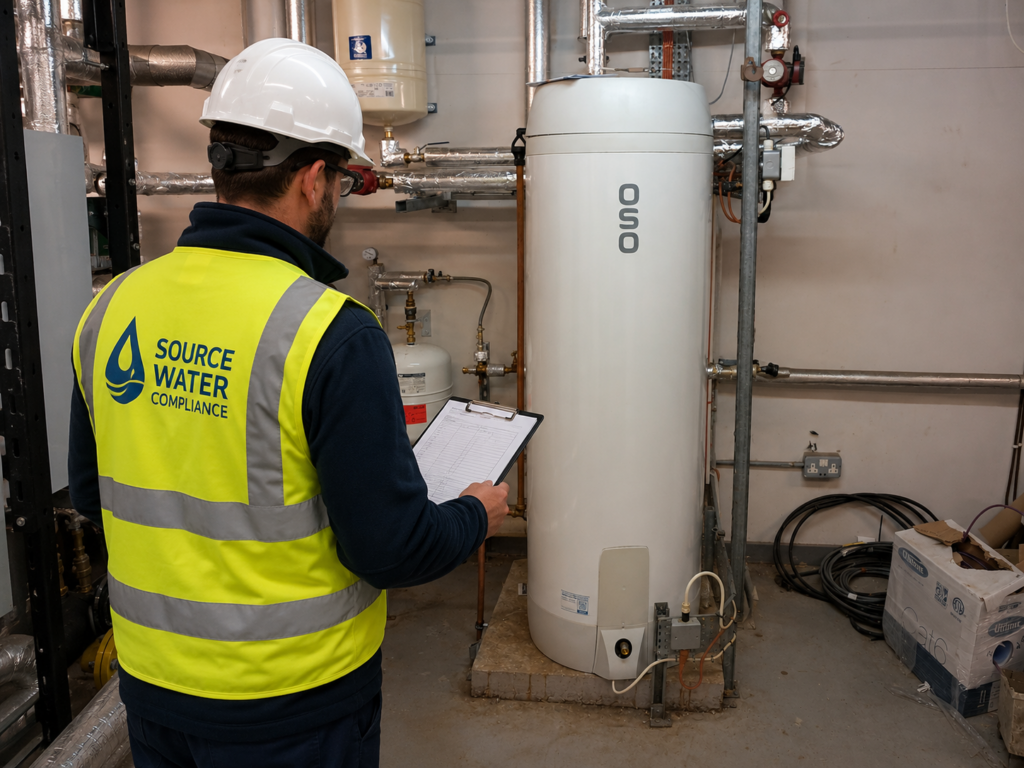
The assessor should establish how water enters the property, how it is stored, how it is heated and how it is distributed throughout the building.
This could include:
- Incoming mains cold water supplies
- Cold water storage tanks
- Booster sets
- Calorifiers
- Hot water cylinders
- Point-of-use water heaters
- Showers
- Taps
- Thermostatic mixing valves
- Expansion vessels
- Distribution pipework
- Other associated water system plant
Understanding the system is essential before the risks can be properly evaluated.
Identification of Potential Hazards
The assessment should identify areas where Legionella bacteria could potentially multiply.
This can include areas of stagnation, inappropriate temperatures, stored water, poor system configuration or locations where aerosols may be generated.
Temperature Checks
Hot and cold water temperatures are an important indicator of whether a conventional temperature-controlled water system is operating effectively.
Cold water should normally be maintained below 20°C, where reasonably practicable.
Hot water systems should be designed and operated so that appropriate control temperatures can be achieved throughout the system.
Temperature readings taken during the assessment can help identify problems such as heat gain, poor circulation, inadequate hot water generation or excessive pipe runs.
Identification of Susceptible People
Some people are at greater risk from Legionnaires’ disease than others.
The risk assessment should therefore consider who uses or occupies the building.
This is particularly important in:
- Hospitals
- Healthcare environments
- Care homes
- Residential care settings
- Other locations occupied by potentially vulnerable people
The vulnerability of occupants can have a significant effect on the overall level of risk.
Review of Existing Management Controls
A Legionella risk assessment should not focus solely on the physical plumbing system.
The management arrangements used to control the water system are equally important.
The assessor should consider areas such as:
- Appointment of a responsible person
- Staff competence
- Written Scheme of Control
- Temperature monitoring
- Flushing regimes
- Tank inspections
- Shower cleaning and descaling
- Water heater maintenance
- Microbiological sampling where applicable
- Record keeping
- Contractor management
- Previous remedial actions
- Arrangements for reviewing the assessment
A technically well-designed water system can still present problems if it is not being properly managed.
Water System Schematic
For larger or more complex systems, an up-to-date water system schematic is an important part of effective water safety management.
A schematic can help identify:
- Incoming water supplies
- Cold water storage tanks
- Calorifiers
- Water heaters
- Distribution routes
- Significant plant
- Major water system components
The schematic should provide a clear overview of how water moves around the building.
Recommendations and Remedial Actions
Where deficiencies are identified, the report should clearly explain what action is required.
Recommendations might include:
- Removing redundant pipework
- Removing dead legs
- Improving cold water temperatures
- Improving hot water temperatures
- Cleaning cold water storage tanks
- Improving tank configuration
- Introducing flushing regimes
- Improving pipe insulation
- Reconfiguring water heaters
- Improving monitoring programmes
- Carrying out additional investigation
- Undertaking microbiological sampling where appropriate
Recommendations should ideally be prioritised according to the level of risk.
Does a Legionella Risk Assessment Include Water Sampling?
Not necessarily.
A Legionella risk assessment and Legionella water sampling are two different things.
Sampling may form part of a monitoring programme, investigation or verification process, but simply taking a water sample does not replace the need for a suitable risk assessment.
Whether Legionella sampling is required will depend on factors including:
- The type of water system
- The findings of the risk assessment
- The effectiveness of existing controls
- Previous microbiological results
- The building occupants
- Applicable sector-specific guidance
A water system can potentially contain significant design or management deficiencies even if an individual Legionella sample returns a satisfactory result.
Effective Legionella control therefore focuses on managing the conditions that allow bacteria to grow, rather than relying solely on occasional water sampling.
How Often Should a Legionella Risk Assessment Be Carried Out?
There is no single fixed assessment interval that is appropriate for every building.
A Legionella risk assessment should instead be reviewed regularly and whenever there is reason to believe that the existing assessment may no longer be valid.
A review may be required following:
- Alterations to the water system
- Installation of new water systems
- Removal of water storage tanks
- Installation or replacement of calorifiers
- Changes to water heaters
- Significant plumbing alterations
- Changes in building occupancy
- Extended periods of low occupancy
- Changes involving vulnerable occupants
- Persistent temperature failures
- Positive Legionella results
- Failure of existing control measures
- Changes in management responsibilities
- Changes in building use
- New information indicating that the existing assessment may no longer be suitable
A Legionella risk assessment should therefore be considered a working water safety document, rather than something that is completed once and then simply filed away.
Who Can Carry Out a Legionella Risk Assessment?
The person carrying out the risk assessment must be competent to do so.
Competence is based on a combination of appropriate:
- Knowledge
- Training
- Experience
- Skills
- Understanding of water systems
- Understanding of Legionella control
- Familiarity with relevant legislation and guidance
For very simple systems, a suitably competent person within an organisation may be able to undertake the assessment.
For larger, more complex or higher-risk sites, appointing an experienced independent Legionella risk assessor will often be more appropriate.
A competent assessor should understand:
- Domestic water system design
- Cold water storage
- Hot water generation
- Water distribution systems
- Legionella growth conditions
- Temperature control
- Stagnation risks
- Aerosol generation
- Water hygiene management
- Relevant HSE guidance
- Sector-specific requirements
The quality of the assessment is important because the recommendations made will often form the basis of the organisation’s ongoing water safety programme.
What Happens After the Legionella Risk Assessment?
Completing the assessment is only the beginning of effective Legionella management.
Where risks are identified, suitable precautions must then be put in place.
Depending on the findings, this may include:
- Developing a Written Scheme of Control
- Appointing a responsible person
- Establishing temperature monitoring
- Implementing flushing programmes
- Monitoring infrequently used outlets
- Inspecting cold water storage tanks
- Maintaining calorifiers and water heaters
- Cleaning and descaling showers
- Cleaning and maintaining outlets
- Carrying out microbiological sampling where appropriate
- Completing remedial plumbing works
- Improving insulation
- Removing redundant pipework
- Maintaining suitable records
- Reviewing the effectiveness of control measures
The risk assessment should provide the foundation for these ongoing control measures.
What Is a Written Scheme of Control?
Where the risk assessment identifies a foreseeable risk from exposure to Legionella, an organisation may need to establish a suitable Written Scheme of Control.
This document sets out how the identified risks will be managed on an ongoing basis.
A Written Scheme may include:
- Details of the water system
- Water system schematics
- Responsible persons
- Control measures
- Temperature monitoring requirements
- Flushing frequencies
- Inspection programmes
- Cleaning and maintenance requirements
- Microbiological sampling requirements
- Record-keeping arrangements
- Corrective actions
- Review procedures
The Legionella risk assessment identifies the risks.
The Written Scheme then explains how those risks will be controlled and monitored.
Why Is a Good Legionella Risk Assessment Important?
A good risk assessment provides a clear understanding of the building’s water system and forms the foundation of an effective Legionella control programme.
A properly completed assessment can help organisations:
- Protect employees
- Protect residents
- Protect patients
- Protect visitors and contractors
- Identify potentially dangerous water system conditions
- Understand legal responsibilities
- Prioritise remedial works
- Establish suitable monitoring programmes
- Demonstrate that Legionella risks are being actively managed
- Improve water system management
- Avoid unnecessary testing
- Maintain appropriate records
- Identify problems before they become more serious
Most importantly, a good Legionella risk assessment should provide clear and practical recommendations.
The purpose should not simply be to produce a large report.
The assessment should help the person responsible for the building understand:
What is wrong?
Why does it matter?
What needs to be done?
How urgently does it need to be addressed?
Legionella Risk Assessments from Source Water Compliance
At Source Water Compliance, we provide independent Legionella risk assessments for organisations across a wide range of sectors and building types.
Our assessments examine both the physical water system and the management arrangements used to control Legionella risk.
We aim to produce straightforward, practical reports that clearly identify:
- How the water system operates
- Existing Legionella control measures
- Areas of concern
- Areas of non-compliance
- The level of risk presented
- Recommended corrective actions
- Priorities for ongoing water management
Our approach is focused on giving clients practical information they can use to effectively manage their water systems.
Whether you manage a small commercial property, residential development, hotel, healthcare environment or a large multi-building estate, the starting point for effective Legionella control is understanding the system and its risks.
Need a Legionella Risk Assessment?
If you require a new Legionella risk assessment, a review of an existing assessment or advice on your current water hygiene and Legionella management arrangements, Source Water Compliance can help.
Contact us to discuss your site and water safety requirements.
Source Water Compliance
Assess | Manage | Comply
Leave a Reply