

Practical Water Hygiene Support for Commercial Properties
Commercial buildings can contain water systems ranging from simple mains-fed office facilities to large, multi-storey systems incorporating stored water, boosted supplies, calorifiers, circulation systems and numerous tenant areas.
Changes in occupancy, refurbishment, vacant floors and alterations to tenant spaces can all affect water turnover and introduce areas of stagnation.
Source Water Compliance provides independent Legionella risk assessments and water hygiene consultancy for offices, commercial properties and multi-tenant buildings.
We work with facilities managers, property managers, landlords, managing agents and responsible persons to identify risks and provide practical recommendations for controlling them.
Why Commercial Buildings Need Effective Water Management
Commercial premises can change considerably throughout their lifetime.
Floors may be refurbished, tenants may move in and out, offices can remain vacant and water systems may be altered as part of fit-out works.
This can leave parts of the original system operating differently from the way they were originally designed.
Typical systems and areas may include:
- Incoming mains water supplies
- Cold water storage tanks
- Booster sets
- Calorifiers
- Hot water circulation systems
- Point-of-use water heaters
- Office kitchens and tea points
- Staff washrooms
- Showers and changing facilities
- Accessible facilities
- Landlord common areas
- Tenant areas
- Cleaning cupboards
- External taps
- Expansion vessels
- Thermostatic mixing valves
- Water softeners
- Low-use outlets
- Vacant floors or units
- Redundant pipework
The Legionella risk assessment should consider both the physical water system and how the building is currently occupied and managed.
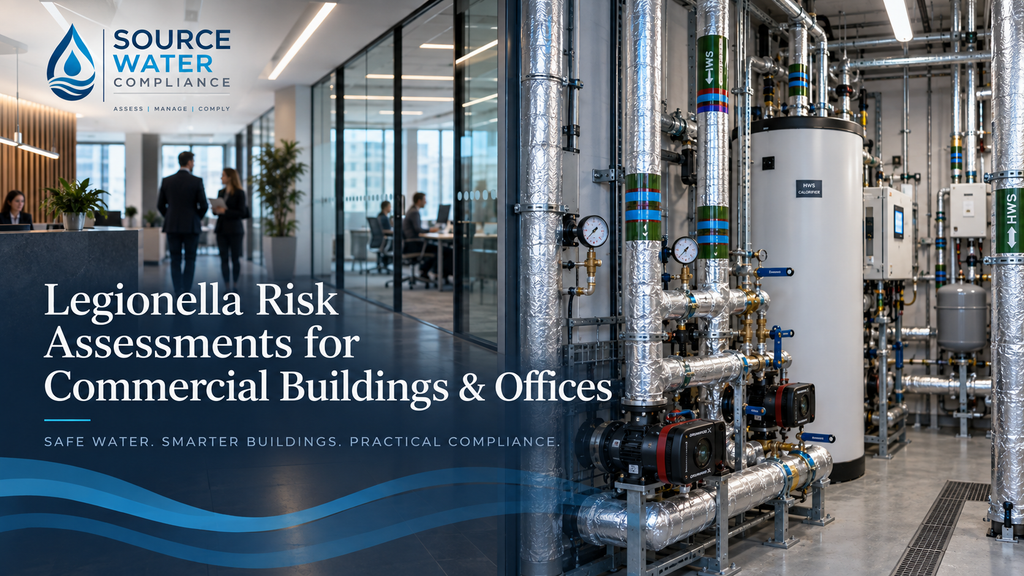
Commercial Legionella Risk Assessments
Our assessments involve a detailed inspection of the hot and cold water systems together with a review of existing Legionella control arrangements.
Depending on the property, this may include:
Incoming Water Supplies
Identification of incoming mains supplies and how water is distributed, stored or boosted throughout the building.
Cold Water Storage
Inspection of cold water storage tanks including condition, temperatures, configuration, turnover and associated pipework.
Hot Water Systems
Assessment of calorifiers, central hot water systems, circulation loops and point-of-use heaters.
Office and Tenant Areas
Review of representative outlets serving occupied offices, tenant spaces, kitchens, washrooms and welfare facilities.
Showers and Changing Facilities
Assessment of shower facilities, particularly where use may be intermittent or linked to cycling, gyms or staff welfare areas.
Low-Use and Vacant Areas
Identification of outlets where water turnover may be poor.
This can include:
- Vacant office floors
- Empty tenant units
- Spare meeting rooms
- Little-used kitchens
- Remote washrooms
- Showers with limited use
- Areas awaiting refurbishment
- Temporarily closed floors
Water Temperatures
Representative temperature monitoring can be undertaken to assess the effectiveness of the existing control strategy.
HSG274 Part 2 advises that, where temperature is used as the control measure, cold water should generally be maintained below 20°C where possible, while hot water should be stored at least at 60°C and reach 50°C within one minute at outlets outside healthcare environments.
System Configuration
The assessment can identify issues including:
- Dead legs
- Dead ends
- Redundant pipework
- Poor circulation
- Excessive pipe runs
- Heat gain into cold water systems
- Stagnation
- Inappropriate alterations following fit-outs
Multi-Tenant Buildings and Dutyholder Responsibilities
Commercial buildings can involve several organisations with responsibility for different parts of the water system.
For example, a landlord may be responsible for:
Incoming water → storage → central plant → landlord areas
while individual tenants may control:
Tenant kitchens → washrooms → showers → locally installed water heaters
HSG274 recognises that several dutyholders may have responsibilities within a single building.
The risk assessment should therefore establish, as far as reasonably possible:
- Who controls each part of the system
- Where landlord responsibility ends
- Where tenant responsibility begins
- Who carries out monitoring
- Who manages low-use outlets
- Who responds to non-compliances
- Who maintains shared plant
- How information is communicated between parties
Clear responsibility is particularly important in large office buildings and mixed-use developments.
Changing Occupancy and Vacant Office Space
Commercial buildings increasingly experience changing patterns of use.
Hybrid working, flexible offices and changing tenant occupancy can mean some outlets receive considerably less use than they once did.
An office floor designed for several hundred occupants may operate with substantially fewer people present on certain days.
This can affect water turnover.
Areas requiring consideration may include:
- Vacant floors
- Partially occupied offices
- Meeting suites
- Showers
- Satellite kitchens
- Remote washrooms
- Former tenant areas
- Spaces awaiting refurbishment
A suitable control programme should reflect actual use rather than assumed occupancy.
Tenant Fit-Outs and Refurbishment
Commercial properties are frequently altered as tenants move in and out.
Fit-out works can introduce new water heaters, kitchens, showers and washrooms or leave sections of older pipework redundant.
Over time this can create increasingly complicated distribution systems.
Our assessments consider evidence of:
- Redundant branches
- Capped pipework
- Extended pipe runs
- Poorly positioned water heaters
- Unused outlets
- Altered circulation systems
- Poorly configured expansion vessels
- New TMVs or flexible hoses
- Incomplete decommissioning
This is particularly relevant within older buildings that have undergone multiple refurbishments.
Practical Recommendations — Not Just a Report
Our reports provide clear and prioritised recommendations based on the findings of the assessment.
Typical actions may include:
- Reviewing flushing programmes
- Removing redundant pipework
- Improving hot water circulation
- Investigating high cold water temperatures
- Adjusting temperature control
- Reviewing little-used outlets
- Maintaining cold water storage tanks
- Servicing thermostatic mixing valves
- Reviewing tenant responsibilities
- Improving monitoring records
- Updating the Written Scheme of Control
- Reviewing procedures for vacant areas
- Undertaking further investigation where required
The objective is to provide proportionate recommendations that facilities and property teams can realistically manage.
Working in Accordance With Legionella Guidance
Our commercial Legionella risk assessments take account of applicable guidance including:
HSE Approved Code of Practice L8 – Legionnaires’ disease
HSG274 Part 2 – The control of legionella bacteria in hot and cold water systems
L8 gives Approved Code of Practice status to matters including risk assessment, appointment of a competent responsible person, the control scheme and review of control measures.
HSG274 provides the detailed technical guidance used to support the assessment and control of risks within hot and cold water systems.
Supporting Commercial Properties After the Assessment
Source Water Compliance can provide ongoing support including:
Legionella Risk Assessments
Detailed assessment of hot and cold water systems throughout commercial premises.
Written Schemes of Control
Development or review of site-specific procedures detailing monitoring, responsibilities and corrective actions.
Water Hygiene Audits
Independent review of existing water hygiene arrangements and contractor performance.
Water System Schematic Drawings
Clear schematics showing principal storage, generation and distribution systems.
Water Hygiene Consultancy
Support following refurbishment, tenant changes, unusual monitoring results, sampling results or changes to the water system.
Commercial Properties We Can Support
We can provide water hygiene support for:
- Office buildings
- Corporate headquarters
- Business centres
- Co-working spaces
- Multi-tenant offices
- Mixed-use commercial properties
- Retail properties
- Shopping centres
- Commercial estates
- Landlord-controlled common areas
- Managed office buildings
- Vacant commercial properties
- Property management companies
- Facilities management organisations
- Multi-site commercial portfolios
Independent Water Hygiene Consultancy
Source Water Compliance provides independent water hygiene consultancy focused on identifying actual risk and delivering practical recommendations.
For landlords, managing agents and facilities teams, this means providing a clear understanding of:
what the problem is, who is responsible, what needs action and what should be prioritised.
Arrange a Commercial Legionella Risk Assessment
If you manage an office, commercial property or multi-tenant building and require a Legionella risk assessment or review of your existing water hygiene arrangements, speak to Source Water Compliance.
We can discuss the property, occupancy, water systems and responsibility structure to determine the appropriate scope of assessment.