

Routine Monitoring to Keep Water Systems Under Control
A Legionella risk assessment identifies the risks within a water system and the Written Scheme of Control explains how those risks should be managed.
Routine water hygiene monitoring provides the evidence that those controls continue to work.
Source Water Compliance provides planned water hygiene monitoring for commercial, healthcare, education, hospitality, industrial, residential and facilities-managed properties.
Our monitoring programmes can be tailored to the water systems present, the findings of the Legionella risk assessment and the requirements of the site’s Written Scheme of Control.
Why Water Hygiene Monitoring Matters
Water systems do not remain static.
Temperatures can change, circulation can deteriorate, outlets can fall out of use and building occupancy can alter over time.
Routine monitoring helps identify these changes before they develop into larger water hygiene problems.
HSG274 Part 2 provides practical monitoring guidance for hot and cold water systems and recommends regular checks of temperatures and other control measures where temperature is being used as the primary Legionella control strategy.
Monitoring also creates a documented record showing whether the control programme is being implemented.
What Can We Monitor?
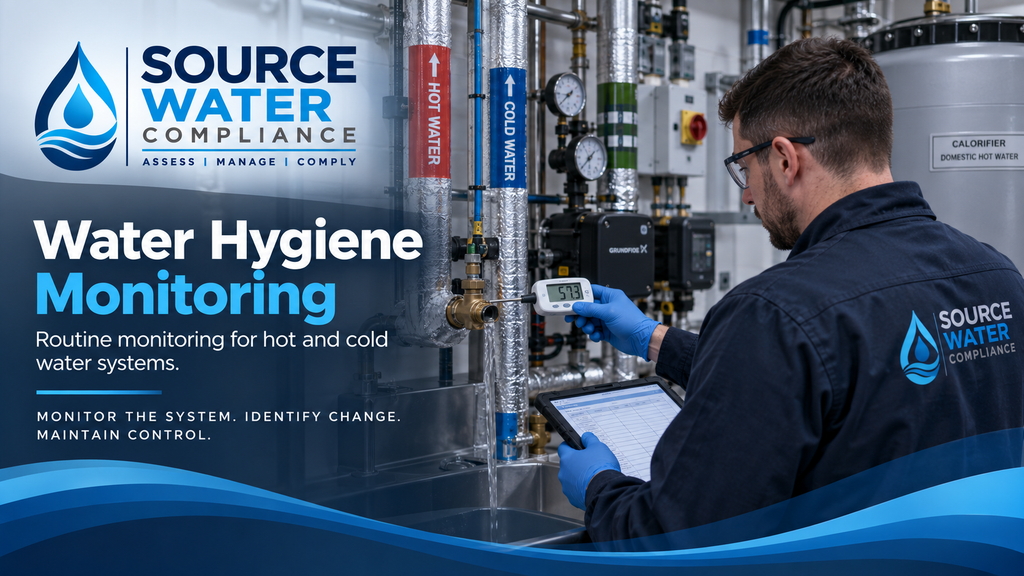
The exact programme should reflect the individual site, but monitoring may include:
- Hot and cold water outlet temperatures
- Sentinel outlet temperatures
- Representative rotational outlets
- Calorifier flow and return temperatures
- Cold water storage temperatures
- Little-used outlet flushing
- Showerhead and hose condition
- Cold water storage tank inspections
- TMV checks where required
- Expansion vessel checks
- Water softener checks
- Review of monitoring failures and corrective actions
- Recording of changes to occupancy or system use
The purpose is not simply to collect readings. The results need to be reviewed so that developing problems can be identified and acted upon.
Hot Water Temperature Monitoring
Where temperature is used as the principal method of controlling Legionella, the hot water system needs to operate within appropriate temperature parameters.
Monitoring can include calorifier temperatures, hot water circulation temperatures and temperatures at sentinel and representative outlets.
HSG274 Part 2 provides guidance for routine monitoring of hot water systems, including monthly checks at sentinel outlets and rotational checks at representative outlets as appropriate to the system.
Repeatedly slow temperature recovery or consistently low temperatures may indicate issues such as poor circulation, incorrect balancing, inadequate plant performance or low water use.
Rather than simply recording the failure, these results should trigger investigation.
Cold Water Temperature Monitoring
Cold water should remain cold.
Where cold water temperatures become elevated, the conditions for microbial growth may become more favourable.
Monitoring can help identify issues such as heat gain from adjacent services, poorly insulated pipework, warm plant rooms, low water turnover or oversized storage.
HSG274 advises that sentinel cold water outlets should typically achieve below 20°C within two minutes and recommends monthly monitoring of sentinel outlets, with representative outlets checked on a rotational basis.
Temperature trends can often reveal developing issues that would otherwise remain unnoticed.
Sentinel and Representative Outlets
Monitoring only one tap does not necessarily provide an accurate picture of a large water system.
A suitable programme may therefore distinguish between sentinel outlets, which are strategically selected locations within the system, and representative outlets, which are monitored on a rotational basis.
This helps build a clearer picture of performance across different floors, branches or zones without unnecessarily monitoring every outlet every month.
The locations and frequencies should reflect the design of the system and findings of the risk assessment.
Little-Used Outlet Flushing
Outlets that receive little or irregular use can allow water to stagnate.
Examples may include spare bedrooms, unused offices, remote washrooms, seasonal facilities, vacant areas, changing rooms or outlets affected by changing occupancy.
Where identified by the risk assessment and Written Scheme, a flushing programme may form part of the control strategy.
The important point is that flushing should be risk based and properly recorded rather than applied blindly to every outlet.
Monitoring can also help identify whether supposedly little-used outlets have changed in use and whether the existing flushing programme remains appropriate.
Cold Water Storage
Cold water storage tanks are an important part of many larger water systems.
Monitoring can include reviewing stored water temperatures and inspecting the condition of tanks.
HSG274 Part 2 gives an annual inspection frequency for cold water storage tanks, with stored water temperature checks normally undertaken annually in summer or more frequently where temperature profiling indicates this is appropriate.
Inspections can consider tank condition, covers, screening, insulation, sediment, stored water condition and general configuration.
Where deterioration or contamination is identified, appropriate corrective action can then be recommended.
Showers and Aerosol-Generating Outlets
Showers can present an increased potential for aerosol generation and require suitable cleaning and maintenance.
HSG274 recommends dismantling, cleaning and descaling removable shower components, heads, inserts and hoses typically on a quarterly basis, or more frequently where fouling or other risk factors justify it.
The appropriate frequency should still reflect the building, water quality, usage and risk assessment.
Monitoring can help identify damaged equipment, heavy scale formation, infrequent use or other issues requiring attention.
Monitoring Records That Are Actually Useful
Monitoring records should provide more than evidence that somebody attended the site.
A useful record should allow the Responsible Person to understand:
What was checked?
What result was obtained?
Was the result satisfactory?
If not, what action was taken?
A recurring temperature failure that is recorded every month without investigation is not effective control.
Source Water Compliance can help identify trends, recurring failures and actions requiring escalation.
Corrective Actions
Where monitoring identifies an unsatisfactory result, the response should reflect the nature and significance of the failure.
This may involve investigation of circulation, flushing, thermostat adjustment, plant maintenance, insulation, system balancing, removal of redundant pipework or further technical assessment.
Where appropriate, microbiological sampling may also form part of an investigation.
The aim is to move from:
failure identified → investigation → corrective action → verification → close-out
rather than allowing outstanding issues to remain indefinitely.
Monitoring Across Multi-Site Portfolios
For organisations responsible for several properties, consistency is particularly important.
Source Water Compliance can provide structured monitoring across portfolios including hotels, commercial properties, education estates, residential developments, industrial facilities and FM contracts.
Using a consistent approach can make it easier to compare performance, identify recurring problems and provide clients with clearer compliance information.
Working With Your Existing Risk Assessment
Monitoring should not operate separately from the Legionella risk assessment.
The assessment identifies the risks.
The Written Scheme defines the control programme.
The monitoring records demonstrate whether that programme is working.
Where monitoring results repeatedly show that control is not being achieved, the risk assessment or Written Scheme may need to be reviewed.
L8 gives Approved Code of Practice status to matters including the control scheme and review of control measures, reinforcing the importance of ongoing management rather than treating Legionella control as a one-off exercise.
More Than Taking Temperatures
Source Water Compliance’s approach is focused on understanding what the readings mean.
Where a result is outside the expected parameters, we can help identify the likely cause and appropriate next steps.
This provides facilities teams and Responsible Persons with useful compliance information rather than simply another set of numbers to file away.
Supporting Services
Water hygiene monitoring can be supported by our Legionella Risk Assessments, Written Schemes of Control, Water Hygiene Audits, Water Hygiene Maintenance & Servicing, Water Sampling & Microbiological Testing, Water System Schematic Drawings and Water Hygiene Consultancy.
Each of those should eventually link directly to the relevant service page as you build them.
Arrange Water Hygiene Monitoring
Whether you require routine monitoring for a single property or a consistent programme across multiple sites, Source Water Compliance can provide a monitoring programme based on the systems present and the site’s Legionella control arrangements.