

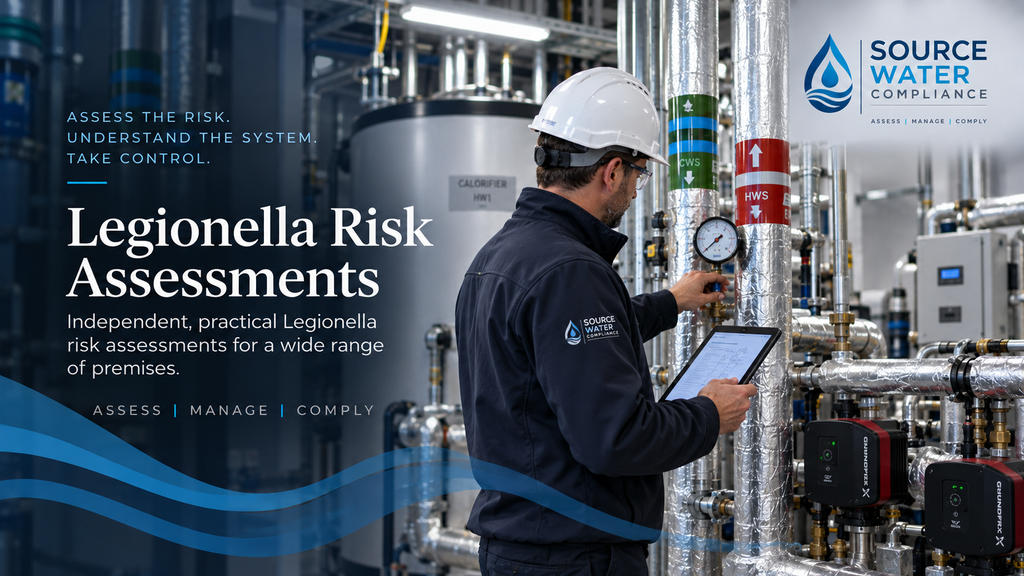
Independent, Practical Legionella Risk Assessments
A suitable and sufficient Legionella risk assessment is the foundation of an effective water hygiene management programme.
It should identify how the water system operates, where conditions may allow Legionella bacteria to grow, who may be exposed and what measures are required to control the risk.
Source Water Compliance provides independent Legionella risk assessments for a wide range of commercial and residential water systems.
Our assessments combine a physical inspection of the water system with a review of the existing management arrangements, monitoring records and control measures.
The result is a clear, practical report identifying what is working, what requires attention and what should be prioritised.
What Is a Legionella Risk Assessment?
A Legionella risk assessment examines the potential for exposure to Legionella bacteria from water systems within a building or premises.
HSE’s Approved Code of Practice L8 gives risk assessment, the role of the responsible person, the control scheme and review of control measures Approved Code of Practice status. HSG274 provides the supporting technical guidance for managing Legionella risks in water systems.
The assessment should consider factors including:
- The design and condition of the water system
- Water storage
- Hot water generation
- Water temperatures
- Stagnation
- Low-use outlets
- Dead legs and redundant pipework
- Poor circulation
- Scale, sediment and deposits
- Aerosol-generating outlets such as showers
- People who may be particularly susceptible
- Existing monitoring and control measures
- Responsibilities for managing the system
A good risk assessment should not simply record what equipment is present. It should consider how the system is actually operating and being used.
What We Assess
Depending on the property and systems present, our Legionella risk assessments may include:
Incoming Water Supplies
Identification of incoming mains water supplies and how water enters and is distributed throughout the premises.
Cold Water Storage
Inspection of cold water storage tanks including:
- General condition
- Configuration
- Temperatures
- Water turnover
- Covers and screening
- Sediment or contamination
- Associated pipework
Hot Water Systems
Assessment of:
- Calorifiers
- Hot water cylinders
- Hot water generators
- Circulation systems
- Return temperatures
- Point-of-use heaters
- Stored water temperatures
Distribution Systems
Review of the way hot and cold water is distributed throughout the premises, including the potential for:
- Stagnation
- Dead legs
- Dead ends
- Poor circulation
- Excessive pipe runs
- Heat gain into cold water systems
- Redundant pipework
Outlets
Representative outlets may be inspected and tested, including:
- Taps
- Showers
- Baths
- Wash hand basins
- Kitchen sinks
- External outlets
- Low-use outlets
Thermostatic Mixing Valves
Where present, TMVs can be considered as part of the wider system, including their location, application and implications for water temperature control.
Additional Equipment
Depending on the site, the assessment may also consider:
- Expansion vessels
- Booster sets
- Water softeners
- Filters
- Flexible hoses
- Emergency showers
- Eyewash stations
- Other relevant water-using equipment
Water Temperature Assessment
Temperature remains one of the principal methods used to control Legionella within conventional hot and cold water systems.
HSG274 Part 2 states that cold water should generally be maintained below 20°C where possible, while hot water should be stored at least at 60°C and distributed so that it reaches 50°C within one minute at outlets, or 55°C in healthcare premises.
During the assessment, representative temperatures can be taken throughout the system to help determine whether the existing control strategy is performing effectively.
Where temperatures fall outside expected parameters, the assessment can help identify possible causes such as:
- Poor circulation
- Excessive heat gain
- Inadequate insulation
- Incorrect thermostat settings
- Low water turnover
- Oversized systems
- Poorly performing plant
Identifying Stagnation and Low-Use Outlets
Stagnation is a common factor in Legionella risk.
HSG274 specifically identifies infrequently used outlets, dead legs, capped pipework and areas of poor circulation as locations where conditions may support microbial growth.
During an assessment, particular attention can therefore be given to:
- Little-used showers
- Vacant rooms
- Spare offices
- Closed wards
- Empty hotel bedrooms
- Seasonal facilities
- Remote washrooms
- Unused kitchens
- Redundant equipment
- Areas awaiting refurbishment
This is especially important where building occupancy has changed since the water system was originally designed.
Review of Existing Water Hygiene Management
A risk assessment should consider more than the physical water system.
We can also review available management information including:
- Previous Legionella risk assessments
- Written Schemes of Control
- Temperature monitoring records
- Flushing records
- Tank inspection records
- Shower cleaning
- TMV servicing
- Cleaning and disinfection records
- Water sampling results
- Maintenance records
- Corrective actions
- Roles and responsibilities
This helps identify whether the controls described on paper are actually being implemented.
Clear, Prioritised Recommendations
Our reports are designed to be used.
Where issues are identified, recommendations are prioritised and clearly explained.
Actions may include:
- Improving temperature control
- Removing redundant pipework
- Investigating poor circulation
- Reviewing low-use outlet flushing
- Improving cold water storage conditions
- Servicing TMVs
- Reviewing shower maintenance
- Improving insulation
- Investigating excessive cold water temperatures
- Updating schematic drawings
- Improving monitoring records
- Developing or updating a Written Scheme of Control
- Further investigation or sampling where appropriate
The objective is to provide proportionate recommendations based on the actual risk identified, rather than generating unnecessary remedial work.
Independent Legionella Risk Assessments
Source Water Compliance provides independent water hygiene consultancy.
That means the purpose of the assessment is to establish the condition of the system and identify the actions genuinely required to manage risk.
Our reports aim to give responsible persons, facilities teams and property managers a straightforward answer to four questions:
What is the risk?
Why is it a risk?
What needs to be done?
What should be prioritised first?
Who Needs a Legionella Risk Assessment?
Those responsible for premises and water systems have duties to assess and control the risk of exposure to Legionella.
HSG274 is written for dutyholders including employers, those in control of premises and others with responsibility for health and safety.
We provide assessments for organisations including:
- Building owners
- Employers
- Facilities managers
- Managing agents
- Landlords
- Property managers
- Hotel operators
- Healthcare organisations
- Education providers
- Industrial and manufacturing businesses
- Residential management companies
- Facilities management providers
Sectors We Support
Our Legionella risk assessments can be undertaken across a wide range of premises.
Hotels & Hospitality
Complex water systems, showers, changing occupancy and low-use bedrooms.
Healthcare
Healthcare water systems, higher-risk clinical environments and particularly susceptible occupants.
Industrial & Manufacturing
Large and complex sites incorporating production, welfare and administrative facilities.
Education
Schools, colleges and universities with changing occupancy and extended holiday shutdown periods.
Commercial Buildings & Offices
Offices, multi-tenant premises, vacant floors and changing tenant arrangements.
Residential & Property Management
Apartment blocks, communal systems, landlords and residential portfolios.
Facilities Management
Single properties, client portfolios and multi-site FM contracts.
When Should a Legionella Risk Assessment Be Reviewed?
A Legionella risk assessment should remain relevant to the current water system and the way the premises are being used.
A review may be appropriate where there has been:
- A significant change to the water system
- Refurbishment
- Changes in occupancy
- A change in building use
- New water-using equipment
- Extended periods of closure
- Significant monitoring failures
- Evidence that existing controls are no longer effective
- Changes in responsibility or management arrangements
The assessment should not simply be treated as a document that is completed and then forgotten.
More Than a Risk Assessment
Following the assessment, Source Water Compliance can also support clients with:
Written Schemes of Control
Clear procedures describing how identified risks should be controlled and monitored.
Water Hygiene Monitoring
Routine monitoring of temperatures and other control measures.
Water Hygiene Audits
Independent reviews of existing water hygiene management arrangements.
Water Hygiene Maintenance & Servicing
Including TMV servicing, outlet and showerhead descaling and other planned hygiene tasks.
Water Sampling & Microbiological Testing
Sampling where appropriate to the system, findings and control strategy.
Water System Schematic Drawings
Clear schematic drawings showing principal water storage, generation and distribution systems.
Water Hygiene Consultancy
Independent support for complex findings, unusual systems, refurbishment and water hygiene issues.
Working in Accordance With Current Guidance
Our Legionella risk assessments take account of applicable guidance including:
HSE Approved Code of Practice L8 – Legionnaires’ disease
HSG274 – Legionnaires’ disease: Technical guidance
For conventional hot and cold water systems, HSG274 Part 2 provides the detailed technical guidance covering design, operation, management and control measures.
Arrange a Legionella Risk Assessment
Whether you manage a single commercial property, complex healthcare environment or multi-site portfolio, we can provide an independent assessment of your water systems and existing Legionella controls.
Speak to Source Water Compliance to discuss your premises and the appropriate scope of assessment.