

Sampling With a Purpose
Microbiological sampling can provide valuable information about the condition and control of a water system — but only when it is undertaken for the right reason.
Source Water Compliance provides water sampling and microbiological testing to support Legionella management, water hygiene investigations and verification of control measures.
Sampling locations and the type of analysis required should be determined by the water system, risk assessment, monitoring history and reason for testing.
Our focus is not simply on collecting samples.
It is on understanding why the sample is being taken, what the result means and what action may be required afterwards.
When Is Legionella Sampling Appropriate?
Routine microbiological sampling is not normally necessary for well-controlled conventional mains-fed hot and cold water systems.
HSG274 Part 2 states that microbiological monitoring of domestic hot and cold water supplied from the mains is not usually required unless the risk assessment or monitoring indicates that there is a problem.
Legionella sampling may be appropriate where:
- Temperature control is not consistently achieved
- There is doubt about the effectiveness of the control regime
- A biocide-based control system is being used
- There are repeated monitoring failures
- Parts of the system experience significant stagnation
- There are high-risk occupants or environments
- Previous sampling has identified Legionella
- Sampling forms part of an investigation
- A water system has undergone significant remedial work
- The risk assessment identifies a specific need for monitoring
HSG274 specifically recommends Legionella monitoring where there is doubt over the effectiveness of the control regime or where the required temperature, disinfectant concentration or other control measures are not being consistently achieved.
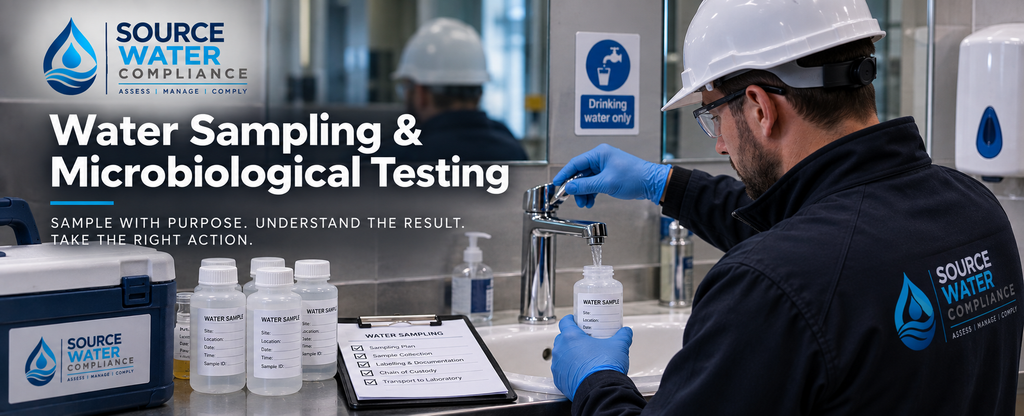
Legionella Sampling
Where Legionella sampling is justified, the sampling strategy should provide useful information about the system rather than simply producing isolated laboratory results.
Potential sampling locations may include:
- Cold water storage and distribution systems
- Hot water systems
- Sentinel outlets
- Representative outlets
- Areas with poor temperature control
- Low-use outlets
- Areas affected by stagnation
- Remote sections of the system
- Areas where previous positive results have occurred
- Higher-risk locations where appropriate
The location, number and type of samples should reflect the complexity of the water system and the reason for sampling.
Sampling From Problem Areas
Sampling can be particularly valuable where routine monitoring identifies areas that are not achieving the expected control parameters.
HSG274 identifies sampling locations that may warrant investigation, including areas where hot water does not achieve the required temperature, cold water exceeds 20°C, or there are conditions such as low use, stagnation, excess storage, dead legs or other system anomalies.
Sampling can therefore help support investigation of problems such as:
persistent temperature failure → sampling → investigation → corrective action → verification
The result should form part of the investigation rather than being considered in isolation.
Pre-Flush and Post-Flush Sampling
How a water sample is collected can affect what the result tells us.
Depending on the purpose of the investigation, samples may be taken:
Pre-flush
to provide information relating to the outlet and local pipework,
or:
Post-flush
to provide information relating more closely to the circulating or distribution system.
HSG274 advises that samples should be clearly identified with their source and whether they were collected pre- or post-flushing.
The sampling method should therefore reflect the question the investigation is trying to answer.
Representative Sampling
Large water systems can contain hundreds or thousands of outlets.
Simply sampling random taps may produce results that are difficult to interpret.
A sampling strategy may instead consider:
- System configuration
- Stored water
- Hot water circulation
- Temperature performance
- Low-use areas
- Distal outlets
- Previous positive locations
- Areas following remedial works
- Particularly susceptible occupants
- Changes in building use
This provides a more meaningful picture of system performance.
Microbiological Water Quality Testing
Depending on the reason for investigation, water testing may extend beyond Legionella.
Appropriate microbiological analysis can help investigate water quality concerns, verify system condition or provide supporting evidence following certain remedial works.
The exact analysis required should be determined by factors including:
- Water source
- Type of premises
- Intended use
- Risk assessment
- Previous results
- Nature of the concern
- Applicable guidance
Samples requiring laboratory analysis should be handled and analysed using appropriate methods and suitably competent laboratories.
Sampling After Remedial Works
Sampling may sometimes be appropriate following significant corrective work.
Examples may include:
- Cleaning and disinfection
- Significant system modifications
- Tank remediation
- Investigation following positive Legionella results
- Recommissioning following prolonged stagnation
- Corrective works following loss of control
However, a satisfactory laboratory result should not be treated as proof that the underlying issue has been resolved if the system continues to operate outside appropriate control parameters.
The physical and operational cause of the problem still needs to be addressed.
Understanding Positive Legionella Results
A positive Legionella result requires interpretation.
Factors that may need to be considered include:
- Organism count
- Species or serogroup information where available
- Sampling location
- Whether the sample was pre- or post-flush
- Hot or cold water system
- Temperature history
- Occupancy and susceptibility
- Previous results
- System configuration
- Existing control measures
The appropriate response can therefore vary considerably from one site to another.
A laboratory result should be considered alongside the risk assessment and current system performance, rather than treated as a standalone pass-or-fail certificate.
Investigation Following Unsatisfactory Results
Where sampling identifies a potential problem, further investigation may include:
- Reviewing temperature monitoring
- Checking hot water circulation
- Investigating cold water heat gain
- Reviewing tank condition
- Identifying stagnation
- Inspecting low-use outlets
- Reviewing flushing
- Examining system configuration
- Reviewing disinfection procedures
- Repeat or targeted sampling
- Reviewing the Written Scheme of Control
The objective is to identify and correct the reason the system has lost control.
Sampling Is Not a Substitute for Good Water Hygiene Management
A system cannot be managed effectively by sampling alone.
A negative Legionella result represents the sample taken at a particular location and point in time. It does not remove the need for:
- A suitable risk assessment
- Effective temperature control
- Appropriate flushing
- Good system design
- Routine monitoring
- Maintenance
- Clear management responsibilities
- Corrective action when failures occur
HSG274 places microbiological monitoring within the wider Legionella control strategy rather than presenting sampling as the primary method of controlling conventional hot and cold water systems.
That distinction is important.
Sampling in Higher-Risk Environments
The need for microbiological monitoring may be greater where people exposed to the water are particularly susceptible.
HSG274 specifically identifies high-risk areas and populations with increased susceptibility, including certain healthcare and care environments, as situations where Legionella monitoring may be appropriate.
In these environments, the sampling strategy needs to consider both the water system and the people potentially exposed.
Clear Reporting and Follow-Up
Following sampling, the important question is not simply:
“Was Legionella detected?”
It is:
What does the result mean for this particular water system?
Where required, we can help review results alongside:
- Risk assessment findings
- Water temperatures
- Monitoring records
- System schematics
- Previous sampling
- Building use
- Existing control measures
This allows practical recommendations to be made regarding investigation, remediation or further monitoring.
Water Sampling Across Multiple Sites
Source Water Compliance can support sampling programmes across:
- Hotels and hospitality premises
- Healthcare environments
- Schools and education estates
- Commercial properties
- Industrial and manufacturing sites
- Residential developments
- Facilities management portfolios
For multi-site organisations, a consistent sampling strategy and reporting format can make results easier to review across the estate.
Working in Accordance With Guidance
Where Legionella monitoring is appropriate, HSG274 Part 2 states that sampling should be undertaken in accordance with BS 7592 – Sampling for Legionella bacteria in water systems – Code of practice and that the complexity of the system should be considered when determining the number of samples required.
Our approach is therefore based on targeted, risk-based sampling rather than unnecessary routine testing.
Supporting Services
Sampling often sits alongside our other services:
Legionella Risk Assessments
Written Schemes of Control
Water Hygiene Audits
Water Hygiene Monitoring
Water Hygiene Maintenance & Servicing
Water System Schematic Drawings
Water Hygiene Consultancy
These should all eventually become internal links.
Arrange Water Sampling & Microbiological Testing
Whether you need targeted Legionella sampling, investigation following monitoring failures, verification following remedial works or advice regarding an existing laboratory result, Source Water Compliance can help determine an appropriate approach.