

Practical Water Hygiene Support for Residential Properties
Residential water systems range from simple individual dwellings to large apartment developments with communal cold water storage, boosted supplies, central hot water generation and extensive distribution systems.
For landlords, managing agents and property managers, understanding where responsibility sits — and applying controls that are appropriate to the actual level of risk — is essential.
Source Water Compliance provides independent Legionella risk assessments and water hygiene consultancy for residential developments, landlords, managing agents and property portfolios.
Our approach is practical and proportionate, taking account of the type of property, complexity of the water system, occupancy and people who may be exposed.
Residential Properties Are Not All the Same
A small mains-fed flat with an instantaneous water heater presents a very different water hygiene challenge from a twenty-storey apartment building supplied through communal storage tanks, booster sets and central hot water plant.
The level of assessment and control should reflect that difference.
HSG274 Part 2 states that all water systems require a risk assessment, but not all systems require elaborate control measures. In many simple residential properties, regular water use and high turnover mean the risk may be low and only straightforward controls are necessary.
Larger residential buildings, however, can contain systems such as:
- Cold water storage tanks
- Booster sets
- Calorifiers
- Central hot water systems
- Hot water circulation systems
- Communal distribution pipework
- Landlord-controlled outlets
- Showers
- Thermostatic mixing valves
- Expansion vessels
- Water softeners
- Point-of-use water heaters
- External taps
- Bin-store or cleaner facilities
- Gyms and communal amenities
- Low-use outlets
- Vacant apartments
- Redundant pipework
The risk assessment therefore needs to consider the actual property and water system rather than applying the same approach to every residential building.
Residential Legionella Risk Assessments
Our assessments can include a detailed inspection of communal and landlord-controlled water systems together with a review of existing Legionella management arrangements.
Depending on the property, this may include:
Incoming Water Supplies
Identification of incoming mains water supplies and how water is stored, boosted and distributed throughout the development.
Cold Water Storage
Inspection of communal cold water storage tanks, including condition, temperature, configuration, turnover and associated pipework.
Hot Water Systems
Assessment of calorifiers, central hot water generation, circulation systems and associated distribution.
Communal Areas
Review of landlord-controlled outlets located within:
- Communal washrooms
- Gyms
- Changing areas
- Concierge facilities
- Management offices
- Cleaner cupboards
- Refuse areas
- External locations
- Resident amenity spaces
Representative Residential Areas
Where within the agreed scope, representative apartments or residential units can be considered to understand how the communal system interfaces with individual dwellings.
Low-Use Outlets
Identification of areas where poor water turnover or stagnation may occur.
Water Temperatures
Representative temperature measurements can be undertaken to assess the performance of hot and cold water systems.
System Configuration
Assessment of issues including:
- Dead legs
- Dead ends
- Redundant pipework
- Poor hot water circulation
- Excessive pipe runs
- Heat gain into cold water
- Low water turnover
- Inappropriate alterations
Landlords and Legionella Responsibilities
Landlords who provide residential accommodation have a legal duty to ensure that the risk of exposure to Legionella is properly assessed and controlled.
Where a managing or letting agent is involved, HSG274 states that the management agreement should clearly establish responsibility for maintenance, safety checks and Legionella management. If those responsibilities are not clearly allocated, responsibility generally remains with the person who has control of the premises and water system.
This makes clear responsibility particularly important for managed residential developments.
The assessment can help identify:
Who owns the system → who controls it → who monitors it → who maintains it → who responds to failures.
Apartment Blocks and Communal Water Systems
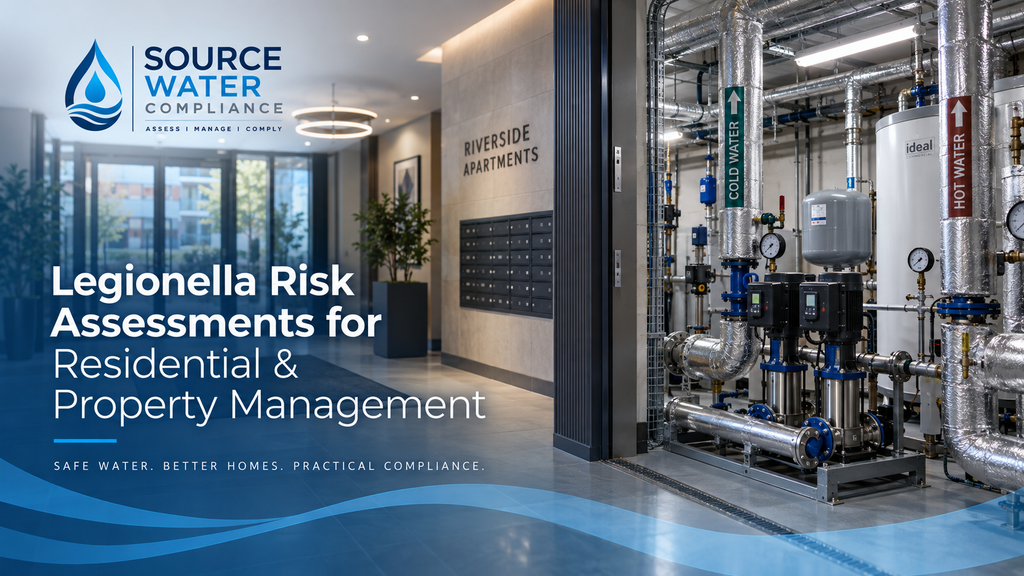
Large apartment developments can have considerably more complex water systems than individual houses or flats.
A typical building may contain:
Incoming mains → storage tanks → booster sets → risers → apartments
and, where centralised hot water is provided:
Cold water supply → calorifiers / hot water generation → circulation system → apartments → return system
In these buildings, problems in communal plant or distribution can potentially affect numerous residents.
Our assessments therefore consider both the major plant and how water is distributed throughout the development.
Void and Unoccupied Properties
Vacant properties can create a particular water hygiene issue because normal water turnover stops.
This may occur when:
- A tenant moves out
- An apartment is awaiting sale
- Refurbishment is taking place
- A development contains unsold units
- Properties remain vacant between tenancies
- Areas are temporarily taken out of use
HSE advises that stagnation should be considered during periods of non-occupancy and that appropriate flushing or other measures may be required.
A suitable management programme should therefore consider:
occupied property → void period → flushing / control → recommissioning → reoccupation
This is particularly useful for managing agents and housing providers responsible for large numbers of properties.
Residential Portfolios
Property organisations may be responsible for hundreds or thousands of individual properties.
Managing Legionella risk across a portfolio requires a proportionate approach.
Not every property requires the same level of inspection, monitoring or ongoing control.
HSE specifically recognises that many straightforward domestic water systems will be low risk and that compliance does not need to be unnecessarily burdensome.
Source Water Compliance can help distinguish between:
simple low-risk domestic systems
and
larger or more complex systems requiring additional management.
This helps property managers focus resources where they are genuinely required.
Housing Associations and Managed Estates
Large residential estates may include several building types constructed at different times.
A portfolio can contain:
- Individual houses
- Low-rise blocks
- High-rise apartment buildings
- Sheltered accommodation
- HMOs
- Hostels
- Build-to-rent developments
- Mixed-use developments
- Older converted properties
- Newly constructed apartment schemes
Each may require a different approach.
Using a consistent assessment methodology across the portfolio can make it easier to identify common issues, prioritise actions and demonstrate how Legionella risks are being managed.
Vulnerable Residents
The potential susceptibility of people exposed to the water should also form part of the assessment.
HSE identifies factors associated with increased susceptibility to Legionnaires’ disease, including age, illness and weakened immune systems.
This can become particularly relevant within residential environments occupied by older residents or people requiring additional support.
Where the resident population presents increased susceptibility, the risk assessment can take this into account when determining appropriate control measures.
No Unnecessary Testing or Over-Complicated Programmes
An important principle of residential Legionella management is proportionality.
HSE states that routine Legionella sampling is not normally required for ordinary domestic hot and cold water systems and also confirms that there is no legal requirement for landlords to obtain a so-called “Legionella test certificate.”
Our approach is therefore based on assessing the actual risk rather than recommending unnecessary testing or ongoing work.
Where a simple residential system presents little risk, the recommendations should reflect that.
Where a larger communal system presents greater complexity, appropriate controls can be identified.
Practical Recommendations — Not Just a Report
Where issues are identified, recommendations may include:
- Reviewing flushing arrangements
- Introducing procedures for void properties
- Improving hot water circulation
- Investigating excessive cold water temperatures
- Removing redundant pipework
- Maintaining cold water storage tanks
- Reviewing tank turnover
- Servicing thermostatic mixing valves
- Reviewing communal outlets
- Clarifying landlord and managing-agent responsibilities
- Improving monitoring records
- Updating the Written Scheme of Control
- Reviewing reoccupation procedures
- Undertaking further investigation where appropriate
The aim is to provide clear, proportionate recommendations that property teams can realistically manage.
Working in Accordance With Legionella Guidance
Our residential assessments take account of applicable HSE guidance including:
Approved Code of Practice L8 – Legionnaires’ disease
HSG274 Part 2 – The control of legionella bacteria in hot and cold water systems
L8 applies to employers and people with responsibility for controlling premises, including landlords, and covers matters including risk assessment, control measures and competent management.
HSG274 Part 2 contains specific guidance for shared premises and residential accommodation, including landlords and managing agents.
Supporting Property Managers Beyond the Assessment
Legionella Risk Assessments
Independent assessment of residential and communal water systems.
Written Schemes of Control
Development or review of site-specific procedures for larger or more complex residential water systems where appropriate.
Water Hygiene Audits
Independent review of existing management programmes, records and contractor performance.
Water System Schematic Drawings
Clear schematics showing communal storage, boosting, hot water generation and distribution systems.
Portfolio Reviews
Support identifying and prioritising higher-risk properties across a residential estate.
Water Hygiene Consultancy
Advice regarding void properties, refurbishment, sampling results, system changes and unusual water hygiene findings.
Residential Properties We Can Support
We can provide support for:
- Apartment blocks
- Residential developments
- Build-to-rent developments
- Housing associations
- Social housing portfolios
- Private landlords
- Property management companies
- Managing agents
- HMOs
- Hostels
- Sheltered accommodation
- Mixed-use developments
- Residential estates
- Multi-building developments
- Communal landlord water systems
- Multi-site residential portfolios
Independent Advice for Property Managers
Our focus is on identifying genuine risk and providing proportionate advice.
For residential property managers, that distinction is important.
A simple domestic system should not be managed like a major centralised apartment water system simply because both are residential.
Our assessments are intended to establish:
what the actual risk is, what controls are justified and where action genuinely needs to be prioritised.
Arrange a Residential Legionella Risk Assessment
If you are responsible for a residential block, property portfolio or communal water system and require a Legionella risk assessment or independent review of your existing arrangements, speak to Source Water Compliance.
We can discuss the properties, water systems and management arrangements to determine the appropriate scope of assessment.