

Independent Review of Your Water Hygiene Management
Having a Legionella risk assessment and Written Scheme of Control in place is only part of effective water hygiene management.
The control measures must also be implemented, monitored and reviewed.
Source Water Compliance provides independent water hygiene audits to help organisations understand whether their existing Legionella management arrangements are working effectively in practice.
Our audits can review the water systems, documentation, monitoring records, responsibilities and contractor activity to identify gaps between what should be happening and what is actually happening on site.
What Is a Water Hygiene Audit?
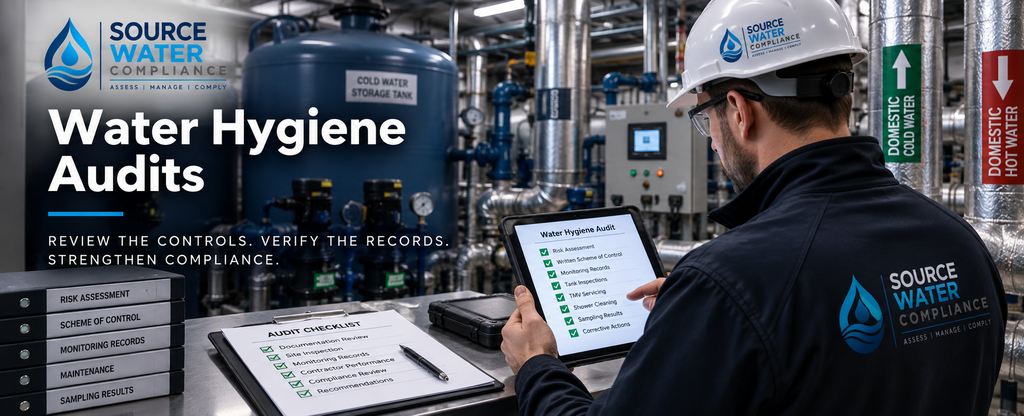
A water hygiene audit is an independent review of the systems and procedures used to manage Legionella and other relevant water hygiene risks.
Unlike a Legionella risk assessment, which focuses primarily on identifying and assessing risk, an audit looks closely at the effectiveness of the existing management programme.
This may include reviewing:
- Legionella risk assessments
- Written Schemes of Control
- Water system schematic drawings
- Temperature monitoring
- Flushing records
- Tank inspection records
- Shower cleaning and descaling
- TMV servicing
- Water sampling results
- Cleaning and disinfection records
- Contractor documentation
- Corrective actions
- Roles and responsibilities
- Evidence that identified actions have been completed
The purpose is to establish whether the current arrangements are suitable, current and being followed.
Reviewing the Risk Assessment
The audit can consider whether the existing Legionella risk assessment still reflects the water system and way the premises are used.
This may include checking whether:
- The assessment remains current
- Significant system changes have been captured
- New plant has been added
- Redundant systems have been removed
- Building occupancy has changed
- Low-use areas have been identified
- Previous recommendations have been completed
- Responsibilities remain correct
A technically sound assessment can become less useful if the building changes significantly after it was completed.
Reviewing the Written Scheme of Control
The Written Scheme should provide a practical description of how identified risks are controlled.
During an audit, we can assess whether it:
- Reflects the current risk assessment
- Accurately describes the water systems
- Allocates responsibilities clearly
- Includes appropriate monitoring frequencies
- Defines acceptable limits
- Contains suitable corrective actions
- Reflects current site practices
The audit can also compare the written procedures against what is actually happening on site.
Monitoring and Record Keeping
Routine monitoring provides the evidence that control measures are operating effectively.
Our audits can review records for:
- Hot water temperatures
- Cold water temperatures
- Calorifier temperatures
- Sentinel outlets
- Representative outlets
- Tank temperatures
- Flushing
- Shower cleaning
- TMV servicing
- Tank inspections
- Expansion vessel checks
- Water treatment parameters
- Microbiological sampling
We can look for gaps, recurring failures, missing corrective actions and trends that may require further investigation.
Are Failures Being Acted On?
Recording an unsatisfactory result is only useful if somebody responds to it.
An important part of a water hygiene audit is therefore checking whether identified failures are:
recorded → investigated → corrected → closed out
Examples may include:
- Hot water failing to reach the required temperature
- Cold water remaining excessively warm
- Repeated flushing failures
- Poor calorifier circulation
- Unsatisfactory tank conditions
- Failed TMV servicing
- Missed monitoring visits
- Positive microbiological results
- Repeated outstanding remedial actions
Where the same problem appears repeatedly without effective resolution, this can indicate a weakness in the management programme.
Contractor Performance
Many organisations rely on external water hygiene contractors to complete monitoring and maintenance.
A water hygiene audit can independently review whether contractor activity appears consistent with the site’s control programme.
This may include examining:
- Monitoring quality
- Record completeness
- Corrective actions
- Temperature testing methodology
- Flushing records
- Tank inspections
- Shower servicing
- TMV servicing
- Sampling programmes
- Recommendations
- Escalation of failures
This can be especially valuable for facilities management teams, property managers and organisations overseeing large contracts.
Site Verification
A documentation review alone may not identify everything.
Where included within the audit scope, a physical site inspection can be used to verify that records and procedures reflect what is actually present.
This may include checking:
- Major water plant
- Cold water storage
- Hot water systems
- Representative outlets
- Low-use areas
- Showers
- TMVs
- Redundant pipework
- Schematic accuracy
- Equipment referenced in monitoring records
This can reveal differences between the written documentation and the actual water system.
Clear Responsibilities
Water hygiene management can involve numerous people and organisations.
These may include:
- Dutyholders
- Responsible Persons
- Facilities managers
- Building managers
- Landlords
- Tenants
- Managing agents
- Water hygiene contractors
- Maintenance contractors
An audit can help establish whether responsibilities are clearly allocated and understood.
Where responsibilities overlap or remain unclear, important tasks can easily be missed.
Independent Compliance Assurance
Water hygiene audits can be particularly useful where an organisation wants an independent view of its current arrangements.
This may be appropriate:
- Before a client audit
- During FM contract mobilisation
- Following a change of contractor
- Following repeated monitoring failures
- Following positive sampling results
- Before reassessment
- Following management changes
- As part of internal governance
- Across a multi-site portfolio
- Where there are concerns about contractor performance
The purpose is not simply to find faults.
It is to establish what is working, what needs improvement and where attention should be prioritised.
Portfolio Water Hygiene Audits
For organisations responsible for multiple sites, a consistent audit approach can help identify recurring issues across the estate.
Source Water Compliance can support:
- Facilities management portfolios
- Hotel groups
- Healthcare estates
- Education estates
- Residential portfolios
- Industrial sites
- Commercial property portfolios
Using a consistent methodology makes it easier to compare properties and identify trends.
For example, repeated issues across several sites may indicate that the problem lies not with one building but with a wider management procedure or contractor process.
Practical Audit Reporting
Following the audit, we provide clear findings and recommendations.
These may include:
- Updating the Legionella risk assessment
- Revising the Written Scheme of Control
- Improving monitoring records
- Reviewing flushing arrangements
- Clarifying responsibilities
- Reviewing contractor performance
- Updating schematic drawings
- Investigating repeated temperature failures
- Completing outstanding remedial actions
- Reviewing sampling arrangements
- Improving corrective-action procedures
Recommendations are designed to be clear, prioritised and practical.
Working Alongside Existing Contractors
A water hygiene audit does not necessarily mean replacing your current contractor.
In many cases, organisations simply want an independent review of the programme they already have.
Source Water Compliance can work alongside existing facilities teams and service providers to identify improvements and provide additional assurance.
That independence can be particularly useful where the same contractor is responsible for:
monitoring → reporting → recommending remedial works → completing the remedial works
An external audit gives the client another perspective on whether the overall programme remains appropriate.
Supporting Services
Following an audit, we can also support clients with:
Legionella Risk Assessments
Where an existing assessment requires renewal or significant revision.
Written Schemes of Control
Where the existing control programme requires updating.
Water Hygiene Monitoring
Where routine control measures need to be implemented or improved.
Water Hygiene Maintenance & Servicing
Including TMV servicing, descaling and other planned water hygiene tasks.
Water Sampling & Microbiological Testing
Where sampling is appropriate as part of investigation or verification.
Water System Schematic Drawings
Where existing drawings are absent, inaccurate or outdated.
Water Hygiene Consultancy
For complex issues, repeated failures or wider compliance concerns.
Arrange a Water Hygiene Audit
If you want an independent review of your current Legionella management arrangements, Source Water Compliance can assess the systems, documentation and control programme and identify where improvement may be required.
Whether you manage a single property or a multi-site portfolio, we can tailor the audit scope to the level of assurance required.