

Practical Maintenance to Support Legionella Control
Effective Legionella management relies on more than risk assessments and monitoring.
Water systems, outlets and associated equipment also require appropriate inspection, cleaning, servicing and maintenance to help ensure the control measures identified within the Written Scheme continue to operate effectively.
Source Water Compliance provides planned water hygiene maintenance and servicing for commercial, healthcare, education, hospitality, industrial, residential and facilities-managed properties.
Our approach is based on the actual system, the findings of the Legionella risk assessment and the requirements of the site’s Written Scheme of Control.
Water Hygiene Maintenance Services
Depending on the water systems and site requirements, our services can include:
- TMV servicing and functional checks
- Showerhead and hose cleaning and descaling
- Tap and outlet descaling
- Cold water storage tank inspections
- Tank cleaning and disinfection
- Expansion vessel checks
- Water heater inspections
- Calorifier checks
- Low-use outlet management
- Cleaning and disinfection of water systems
- Remedial water hygiene works
- Post-maintenance flushing
- Follow-up monitoring
- Support following unsatisfactory sampling results
The maintenance programme should be risk based and site specific, rather than applying unnecessary tasks simply because they appear on a generic checklist.
TMV Servicing
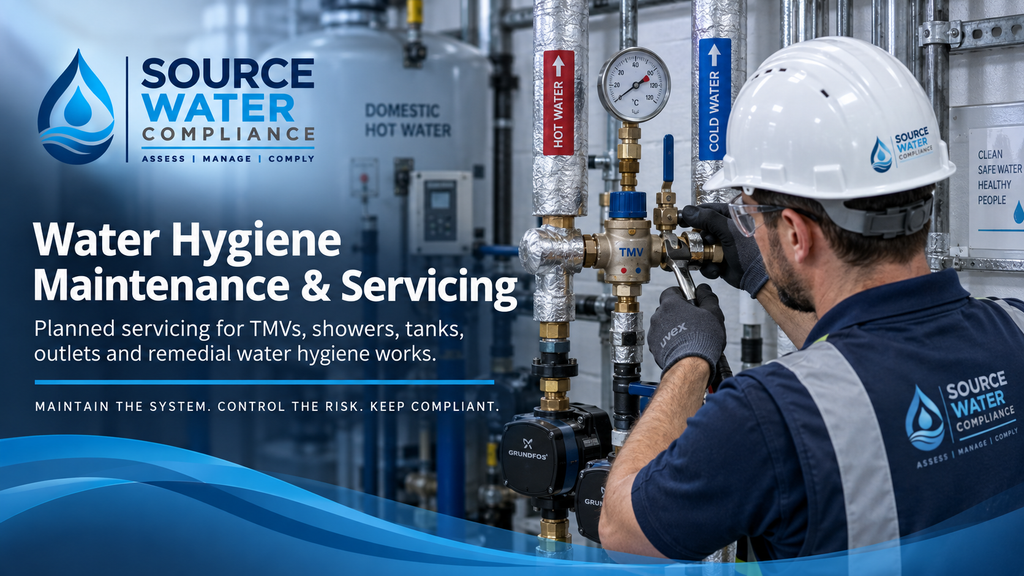
Thermostatic mixing valves are commonly installed where there is a need to reduce the risk of scalding by blending hot and cold water close to the point of use.
However, TMVs also create an area where blended water can remain within a temperature range favourable to microbial growth if the equipment or associated pipework is poorly managed.
Servicing can include:
- Visual inspection
- Temperature checks
- Functional testing
- Failsafe testing where appropriate
- Cleaning of strainers and internal components
- Descaling
- Checking the condition of associated pipework
- Identification of redundant or poorly positioned valves
- Recording results and corrective actions
The servicing frequency should reflect the type of valve, manufacturer’s instructions, site risk assessment and Written Scheme of Control.
Showerhead & Hose Cleaning and Descaling
Showers can generate aerosols and therefore require appropriate management within a Legionella control programme.
Scale and deposits can accumulate within showerheads, inserts and hoses, creating surfaces where biofilm may develop.
HSG274 Part 2 recommends dismantling, cleaning and descaling removable shower components, heads, inserts and hoses, typically quarterly or more frequently where fouling indicates that this is necessary.
Our servicing can include:
- Dismantling removable components
- Cleaning and descaling
- Inspecting hoses and fittings
- Identifying damaged components
- Reassembly
- Flushing
- Recording completion
Where shower components are heavily fouled or damaged, replacement may be more appropriate than repeated cleaning.
Tap and Outlet Descaling
Scale can accumulate on taps, aerators, flow regulators and other outlet fittings.
Where appropriate, servicing may involve removal and cleaning of outlet components to help reduce deposits and maintain good water flow.
Particular attention may be required where:
- Water is naturally hard
- Outlets receive little use
- Aerators are fitted
- Scale accumulates rapidly
- The site contains higher-risk occupants
- Previous inspections have identified fouling
The need for descaling should reflect the actual condition of the outlets rather than being carried out unnecessarily.
Cold Water Storage Tank Inspections
Cold water storage tanks should remain clean, suitably protected and capable of maintaining good water quality.
Inspections can consider:
- Tank condition
- Covers and access hatches
- Screens
- Insulation
- Stored water condition
- Sediment
- Corrosion
- Biofilm
- Internal supports
- Water turnover
- Evidence of stagnation
- Temperature
HSG274 provides guidance for routine inspection of cold water storage tanks and indicates that cleaning and disinfection should be undertaken where inspection shows it to be necessary.
This is important because tank cleaning should be based on condition and risk, rather than automatically assuming every tank requires annual cleaning.
Tank Cleaning & Disinfection
Where inspection identifies significant sediment, contamination, fouling or other unsatisfactory conditions, cleaning and disinfection may be required.
This can involve:
isolation → draining → physical cleaning → disinfection → flushing → reinstatement
The exact procedure should reflect the tank, system and reason for the work.
Following significant works, appropriate verification may also be required before the system is returned to normal service.
Expansion Vessel Checks
Expansion vessels can contain sections of water with limited turnover, particularly where installation or configuration is poor.
Checks may consider:
- Position and orientation
- Connecting pipework
- Evidence of stagnation
- Isolation valves
- General condition
- Suitability of installation
- Whether flushing arrangements are required
Where an expansion vessel or associated pipework creates an avoidable area of stagnation, this can be highlighted for corrective action.
Calorifiers and Hot Water Plant
Hot water generation and circulation are central to many Legionella control programmes.
Maintenance can include inspection or verification of:
- Stored water temperatures
- Flow temperatures
- Return temperatures
- Circulation
- Thermostats
- Drain arrangements
- Insulation
- General condition
- Associated pumps and valves
Repeated temperature failures may indicate a wider system problem rather than simply a monitoring issue.
Where this occurs, further investigation may be required.
Cleaning and Disinfection
Cleaning and disinfection may be appropriate following circumstances such as:
- Significant system alterations
- New installations
- Extended stagnation
- Unsatisfactory microbiological results
- Contamination
- Major tank cleaning
- Recommissioning
- Certain remedial works
The method should be appropriate to the water system and circumstances rather than used as a substitute for correcting the underlying cause of poor control.
Remedial Water Hygiene Works
Risk assessments and monitoring programmes sometimes identify physical defects that require correction.
These may include:
- Redundant pipework
- Dead legs
- Poor insulation
- Inappropriate flexible hoses
- Poorly configured expansion vessels
- Defective TMVs
- Damaged showers
- Poorly performing water heaters
- Low-use branches
- Incorrect system configuration
Where appropriate, Source Water Compliance can help identify and coordinate the actions needed to restore effective control.
Maintenance Should Follow the Risk Assessment
Not every water system requires the same maintenance programme.
The Legionella risk assessment and Written Scheme should help determine:
what needs servicing → how often → who is responsible → what constitutes failure → what happens next
HSE’s Legionella guidance emphasises that control measures should be appropriate to the system and properly implemented and maintained. L8 gives Approved Code of Practice status to matters including the control scheme and review of control measures.
Clear Maintenance Records
Maintenance records should make it easy to establish:
- What equipment was serviced
- When it was completed
- What condition was found
- What results were obtained
- Whether defects were identified
- What corrective action was recommended
- Whether those actions were completed
For multi-site organisations, consistent records can make contractor oversight and compliance reviews considerably easier.
Planned Maintenance Across Multiple Sites
Source Water Compliance can support maintenance programmes across:
- Hotels
- Commercial properties
- Healthcare premises
- Schools and education estates
- Industrial facilities
- Residential developments
- Facilities management portfolios
Using a consistent approach across multiple properties can help standardise servicing, reporting and corrective actions.
Independent and Proportionate Advice
Not every item of water hygiene equipment needs cleaning, replacement or servicing at the same frequency.
Our approach is to base maintenance on:
system design + condition + risk assessment + manufacturer requirements + monitoring history + actual use
This helps avoid unnecessary work while ensuring that genuine water hygiene risks are appropriately addressed.
Supporting Services
This page should eventually internally link to your other service pages:
Legionella Risk Assessments
Written Schemes of Control
Water Hygiene Audits
Water Hygiene Monitoring
Water Sampling & Microbiological Testing
Water System Schematic Drawings
Water Hygiene Consultancy
Arrange Water Hygiene Maintenance & Servicing
Whether you require planned TMV servicing, showerhead descaling, tank inspections or wider support with your water hygiene maintenance programme, Source Water Compliance can provide a service based on the needs of your site.